




WHAT IS AN ENERGY PERFORMANCE CERTIFICATE – EPC
The Energy Performance Certificate for a building or building unit shows the energy rating of a building or building unit, where a building unit is defined as the part, floor, or apartment within a building that has been designed or converted to be used separately—enabling owners or tenants of the building or building unit to compare and evaluate its energy performance.
The PEA is valid for 10 years from the date of issue.
The specialized Energy Inspectors – Engineers of CITY ENGINEERING can issue a PEA for the entire building as and it is possible to issue multiple EPCs, one for each building unit.
In mixed-use buildings, EPCs are issued according to the use. Therefore, in a building where there are shops or offices on the ground floor and apartments/residences on the upper floors, one EPC is issued for each shop/office and one EPC for each apartment (an EPC cannot be issued for both uses).
Energy Performance Certificates (EPCs) are required whenever a property is:
- Under construction
- Available for sale
- Available for rent
ONE CERTIFICATE OF ENERGY EFFICIENCY – PEA CONTAINS:
- Information regarding the use of energy in a property and the typical energy cost
- Recommendations regarding the way to reduce the use of energy and saving money
- The building or building unit is classified on an energy consumption scale from A+ to H when the certificate is issued.
- The responsibility for providing an EPC lies with the owner. For each new construction, the contractor carrying out the construction work must obtain an EPC when it is completed within the specified period.
- An owner must pay for the initial EPC study, providing the prospective buyer or tenant with an EPC before concluding a sale or lease agreement. This information is completed when submitting a lease agreement electronically.
- The obligation to issue an EPC and inform the tenant applies to long-term leases as well as subleases and short-term leases.
See below
OPTIONAL DOCUMENTATION FOR PROPERTIES BUILT BEFORE 14.03.1983
- Copy Topographic Diagram / Sketch.
- Copies of Architectural Plans (Floor Plan/Sketch of the property)
- Title Ownership.
- Sheet Maintenance Boiler.
- Energy consumption bills (e.g., electricity, natural gas).
- If the property is registered in the Land Registry, thing that is not necessary is, the copy of his declaration his declaration.
THE DOCUMENTS FOR REAL ESTATE WHICH HAVE BEEN BUILT AFTER MARCH 14, 1983
- Copies of Architectural Plans (Floor Plan/Sketch of the property)
- Copy Building Permit
- Copy of application for regulation of semi-open spaces (if an application has been made)
- Copy of the property declaration in the Land Registry (if a declaration has been made)
*Clarification: For the conduct of an Energy Inspection, no declaration of the property is required to declare the property in the Land Registry.
And the optional supporting documents,
- Copy Topographic Diagram / Sketch
- Title Ownership
- Sheet Maintenance Boiler
- Study Thermal insulation
OBLIGATION ISSUANCE PEA – LEGISLATION
The issuance of an Energy Performance Certificate (EPC) is mandatory:
- After the completion of construction of a new building or building unit and concerns the buildings with concerns the buildings with building permits that fall under the provisions of the KENAK (the permits that were issued after the commencement of application of the KENAΚ 2010 and fall under its provisions
- After completing a radical renovation of a building or building unit,
- During the sale/purchase of a building or building unit of any size, until the activation of the Identity of the Building
- According to the lease (long-term, short-term, sublease) to a new tenant of a building or building unit, until the activation of the Identity of the Building,
- For buildings with a total surface area of more than two hundred and fifty square meters (250 m²), which are used by public and broader public sector services, as defined from time to time, and which are frequently visited by the public. This category includes any service that is open to the public, such as local government administrative services, school complexes, and ministries. On the other hand, services that are not open to the public, such as buildings housing local government cleaning services, are not included.
- For the inclusion of the property in the program NEW SAVE ENERGY.
- We note that from January 1, 2016, no property is exempt from this requirement, regardless of square footage, from the issuance of the PEA.
STUDY ENERGY EFFICIENCY – MEA
All existing buildings or building units that are subject to a radical renovation subject to radical renovation must comply with the minimum requirements for energy efficiency as specified in the Regulation on Energy Performance of Buildings – KENA.
An Energy Performance Study (EPS) is a study that analyzes and evaluates the energy performance of a building. According to the Building Energy Performance Regulation, in order to obtain a building permit for any new or radically renovated building with a total surface area of more than 50 m², an Energy Performance Study must be prepared and submitted to the competent authority. new or radically renovated with a total surface area of more than 50 m², an Energy Performance Study must be prepared and submitted to the competent Building Authority (Urban Planning). This is an additional study required for the issuance of a building permit and replaces the thermal insulation study, as was the case until the new regulation came into force.
The existing buildings or building units that are being renovated are being renovated radically are examined as a whole and not only by energy perspective so that they are included in the
Study of Energy Efficiency – MEA:
- The necessary measures to ensure healthy indoor climate conditions,
- Examination of passive and active fire protection conditions
- The assessment of risks that may affect their static adequacy.
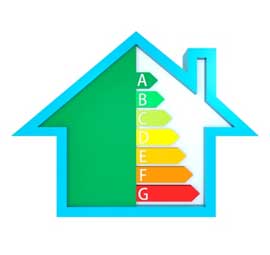
INTO WHICH ENERGY CLASSES IS THE PEA DIVIDED?
There are nine classes, starting with A+ as the highest class and H as the lowest. In between are A, B+, B, C, D, E, and Z. Moving from one class to another is not a simple matter, nor is it something that will happen with certainty if the recommended interventions of the energy inspector/engineer who will carry out the relevant study are not followed. A class A+ building is the most efficient property, with lower fuel bills, and a class H building is the least energy efficient, with higher energy bills. The same scale is used to determine the environmental impact of a building’s carbon dioxide (CO2) emissions.
WHICH PROCEDURE DETERMINES THE ENERGY CLASS OF A BUILDING?
The EPC is issued after processing the relevant building data and comparing it, using special computer programs available to energy inspectors, with an ideal building of the same size and with the same energy needs. This results in its energy class. A comparison is made between the annual primary energy consumed by the building under examination in kW/m² and the same consumption that the ideal building should consume.
From the comparison this arise and the needs that will be proposed by the Energy Inspector – Engineer of CITY ENGINEERING for reducing the annual consumption of primary energy, as well as and any other interventions it considers necessary must be carried out.
WHAT INTERVENTIONS CAN BE PROPOSED BY THE ENERGY INSPECTOR?
The interventions mentioned above are proposals by the Energy Inspector – Engineer of CITY ENGINEERING for the improvement of annual energy consumption and the optimization of living conditions in the building or the building unit.
These proposals may concern the application of some type of insulation to the exterior vertical walls or the roof, the replacement of window frames, the replacement of shading systems, the installation of alternative energy systems (e.g. solar water heater, natural gas heating system, etc.).
These suggestions, which are not limited to the above, can be implemented either individually or in combination for the best possible result. In the case of an extremely energy-intensive home, ideally most, if not all, of the interventions recommended by the energy inspector/engineer of CITY ENGINEERING in the EPC to achieve the desired result.
FOR HOW LONG IS THE PEA VALID?
The EPC is valid for 10 years unless the building or building unit undergoes a major renovation before the end of the 10-year period. In that case, a new EPC must be issued after the completion of the renovation and alterations to the building. Also, if, during the period of validity of the current certificate, the building or building unit is sold or transferred to another party, it is not necessary to issue a new EPC, as the energy certificate accompanies the property and not the natural persons who own it.
Important note: In the case of a control, the non-possession of a P.E.A., the owner may be subject to face fines ranging from 1,000 to 10,000 euros.
Get in touch with us: today for the issuance of your own Certificate of Energy Performance!


PRICE LIST PEA
| SURFACE AREA | COST |
| Up to 100 sq. m. | €48 |
| From 100 sq. m. to 200 sq. m. | €60 |
| From 200 sq. m. And above | €80 |