



External or internal thermal insulation?
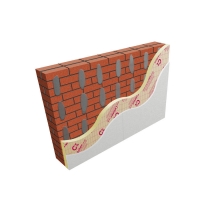
Homes in our country account for a very large percentage, 32%, of total final energy demand. In households, heating alone accounts for 60% of total final energy consumption.
Although the Thermal Insulation Regulation has been in force since 1979, only 30% of buildings have thermal insulation. The combination of age, inadequate protection from the external environment, and a lack of environmental awareness in the design of homes has made Greek homes some of the most energy-intensive in Europe. So what should building owners who want to improve their thermal insulation choose? Internal or external thermal insulation?
Advantages of external thermal insulation
External thermal insulation is applied externally to the facades of buildings and is the optimal way to thermally insulate buildings that operate and are used 24 hours a day (e.g. permanent residences) as it exploits the heat capacity of the solid structural elements of the external masonry (concrete – bricks). It presents a number of advantages:
- Ideal method for renovating and thermally insulating existing buildings
- Energy saving
- Saving useful space
- Elimination of thermal bridges
- Complete waterproofing of facades
- Protection of load-bearing structures
- Optimal energy efficiency
- Architectural freedom
- Adding value to the property
Advantages of internal thermal insulation?
Internal thermal insulation can provide comprehensive thermal insulation, as there are solutions for all building elements (masonry, roof, floors) with excellent thermal transmittance coefficients that exceed even the most stringent requirements of the Greek Building Code (K.E.N.A.K.) and offer particular advantages. Ideal solution for office buildings and holiday homes. In a building that is not used 24 hours a day, rooms with internal insulation heat up faster because the solid structural elements of the external masonry do not need to be heated first.
- Top thermal insulation
- Easy to apply
- Building speed
- Excellent final surface finish
- Low implementation cost
- Best value for money
- Possibility of thermal insulation of individual rooms (e.g., children’s room)
- Interior renovation
Comparison of the two thermal insulation systems:
According to a comparative evaluation of internal and external retroactive thermal insulation systems conducted by the National Technical University of Athens, the following conclusions were reached:
The differences observed between internal and external insulation systems are negligible, making the two systems thermally equivalent, as they have similar U-values and thermal mass. In general, the total energy savings achieved by using internal or external insulation, compared to an uninsulated house, are in the range of 24%-65%. In particular, in terms of energy consumption for heating, the savings achieved are in the range of 60%-93%. External insulation generally leads to greater energy savings (4%-9%) compared to internal insulation. Using typical market prices, the investment for installing internal insulation is estimated to be 50% less than the corresponding investment for installing external insulation. Payback period of 6-9 years compared to 8-12 years.
Undoubtedly, every solution has advantages and disadvantages, but it is obvious that the more alternatives the Energy Inspector can propose to the building owner, the easier it will be to choose the option that will lead to the greatest energy savings per unit cost. In most cases of buildings in cities, where the continuous system prevails and there are many technical difficulties (plot boundaries, building lines, scaffolding, etc.), a mixed system combining internal and external thermal insulation will necessarily be used.