



Legislative Update
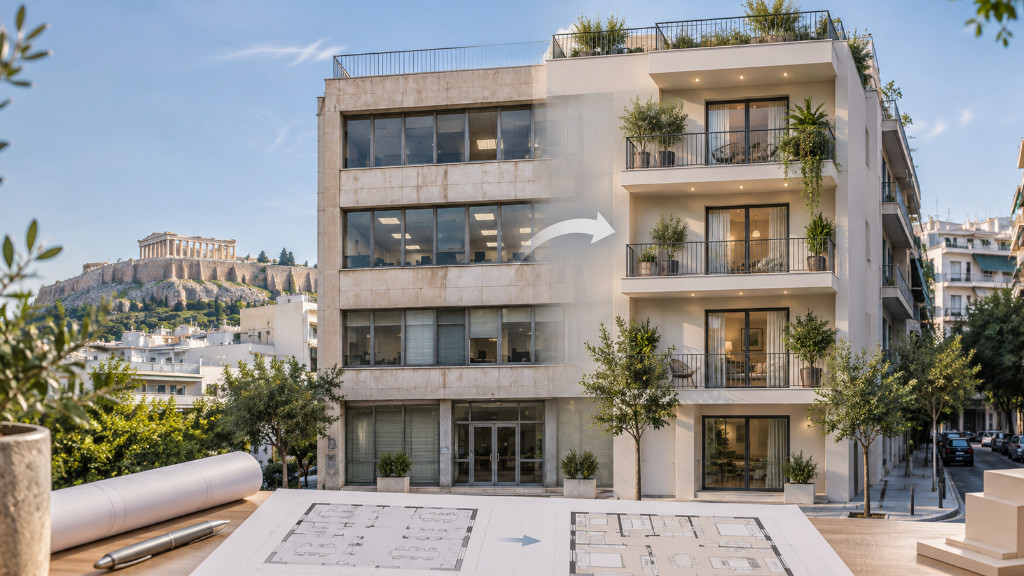
Article 56 of Law 5322/2026, published in the Government Gazette A’ 117/July 24, 2026, amended Article 199 of Law 5306/2026 regarding the use of buildings. The provision creates new opportunities for changing the use of existing buildings to residential use, subject to specific conditions.
What are the regulations for buildings within a zoning plan?
For legally existing buildings within an approved plan or settlement, a change of use is generally still evaluated based on the street layout plan and the land uses in the area.
The law provides for a special option to change the use of a building to residential, even regardless of the current land-use designations, for buildings that have been granted an exemption through December 31, 2025. Before a building permit for the new use is issued, a favorable opinion from the Central Council of Architecture is required.
What are the regulations for buildings outside the city plan?
For legally existing buildings located outside the city plan and outside settlement boundaries, a change of use to residential is permitted on an exceptional basis, regardless of the applicable land-use designations and certain general or specific restrictions governing the property.
The new use applies to the legally established building envelope: the volume, floor area, or coverage may not be increased. The change of use may be made only once, and this option remains available even if the area is subject to urban planning in the future.
This regulation also applies to buildings for which the process of compliance with Laws 4178/2013 or 4495/2017 has been completed. In certain cases involving buildings granted an exemption, an additional opinion from the Central Council of Architecture and a special reciprocal fee are required.
Building permit or Electronic ID update?
The general procedure depends on the type of change. When the change of use results in a more unfavorable change to the building plan or the loads in the structural analysis, or changes to the technical and mechanical systems regarding their routing through other floors or common areas, a building permit is required, and the Electronic Building ID must be updated.
Simply updating the Electronic ID without a building permit does not automatically apply to the specific cases of change of use provided for in the new provisions. An assessment of the characteristics and work performed on each property is required.
Restrictions the owner needs to be aware of
– For residential properties resulting from the special cases covered by this regulation, short-term rentals are not permitted for at least five years following the completion of the change of use.
– For every change of use, accessibility to common areas must be ensured, provided that the load-bearing structure is not compromised.
– A change of use to a parking lot is not covered by the special exception under Article 56 for residential properties. It is reviewed based on applicable urban planning regulations and the land uses in the area.
Before the process begins
The possibility of changing a building’s use does not mean that every building can automatically be converted into a residence. It is necessary to verify the legality of the building and the area, any exemptions, and the required permitting process.
Legal basis: Article 56 of Law 5322/2026, Government Gazette A’ 117/July 24, 2026, which amended Article 199 of Law 5306/2026.