



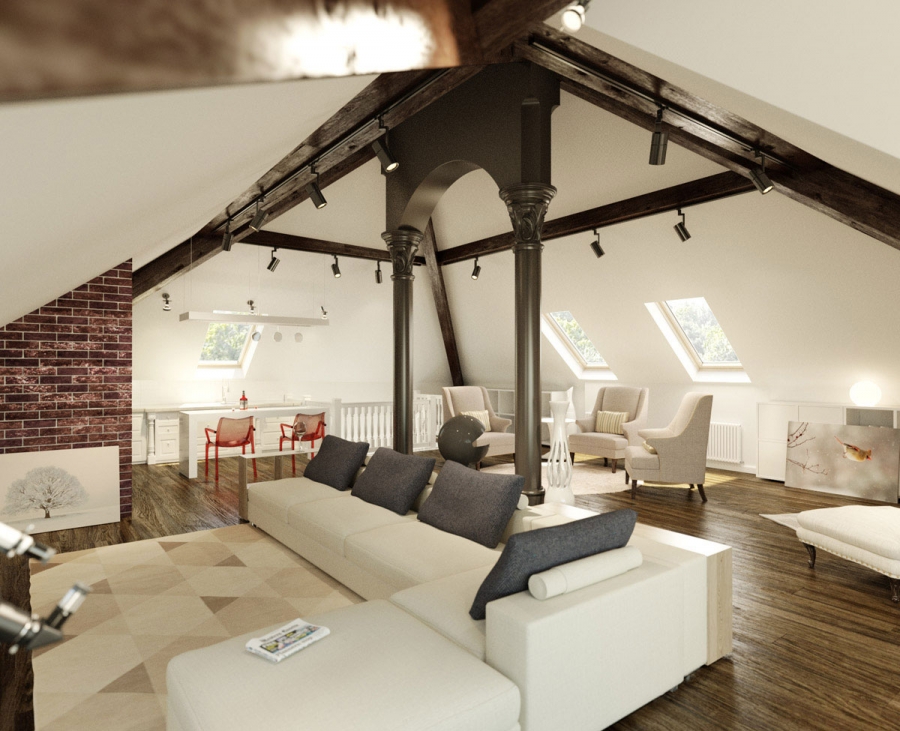
Possibility of adding open semi-open-air spaces, open balconies and attics in legally existing buildings erected with provisions prior to Law 4067/12 (NOK) provisions
In response to a question and prompted by the amendments introduced by the new institutional framework for building construction – New Building Regulations and, on the other hand, questions from Building Services and private individuals regarding the possibility of adding open semi-covered spaces, open balconies, and attics to legally existing buildings constructed under provisions prior to Law 4067/12 (NOK), the following is clarified:
A) Attics:
From the combination:
■ Article 2, paragraph 81 of Law 4067/2012, according to which “An attic is an open or closed accessible space located within the height of the sloping roof of the building and cannot constitute independent property.”
■ Article 11(6) of Law 4067/2012, which stipulates that “The following are not included in the floor area:… (j) Attics with a total area less than or equal to 1/2 of the area of the underlying floor plan to which they are functionally connected, without constituting an independent floor and provided that the average free height is less than 2.20 m.” and
■ Article 23(3) of Law 4067/2012, according to which “Additions to legally existing buildings are permitted… a) By extension or height in accordance with the provisions of this law and in accordance with the specific urban planning provisions in force in the area. The total exploitation may not exceed the building coefficient of the area in force at the time of granting the building permit for the addition.” it follows that it is possible to add a roof and attic to a legally existing building, or to add an attic within a legally existing roof of a building, provided that the conditions for classifying the space as an “attic” are met (paragraph 81 of Article 2 of Law 4067/2012) and the general and any specific building conditions and restrictions applicable in the area of the property are complied with. It should be noted that, in all cases, the functional connection of the attic to the floor below it must be ensured.
With regard to the possibility of accessing and extending the attic to an open balcony or roof of the building that is continuous with its floor, this is not permitted, as the attic, as a space within the roof of the building, is not included in the number of floors of the building (in line with internal balconies, which are explicitly stated in their definition as not constituting a floor) and therefore its floor cannot be extended horizontally in order to create an open balcony (as defined in paragraph 5 of Article 2 of Law 4067/2012).
Furthermore, in this case, the attic would acquire the characteristics of an independent floor, which would have to be taken into account in the actual building coefficient of the plot of land. Furthermore, according to Article 2 of Decision No. 63234/19.12.2012 of the Deputy Minister of the Environment, Energy and Climate Change (which approved the Technical Guidelines of the NOK), it is clarified that “openings in the roof that follow its stereometry are permitted, as well as openings in any walls that are part of it, for the lighting and ventilation of the space,” it is clear that the openings constructed in attics are intended solely for lighting and ventilation purposes.
B) Open semi-covered areas and open balconies:
According to the wording of Article 11(6)(a) of Law 4067/2012, which stipulates that “The following shall not be included in the calculation of the floor area: a. The surface area of open balconies and open semi-covered spaces, when the total surface area of these spaces is less than or equal to 40% of the surface area that may be built on the plot. In any case, the percentage of open semi-covered spaces may not exceed 20% of the area that may be built on.” In conjunction with Article 23 of the same law, concerning additions, it follows that it is possible to add or extend a legally existing building, open semi-covered space and open balcony, regardless of the existence of remaining building rights on the property, under the following conditions:
1. The following shall be observed the general and any more specific terms of construction and restrictions that apply in the area of the property,
2. The conditions characterizing these spaces and functional elements, as defined in paragraphs 5 and 6 of Article 2 of Law 4067/2012, are met.
3. The technical safety requirements of the construction are met, as certified by the competent engineer, within the framework of the studies submitted for the issuance of the relevant building permit.
4. For open balconies, the conditions of paragraphs 2 and 3 of Article 16 of Law 4067/2012 are met, with the proviso that their construction within the mandatory uncovered parts of the plot (side and rear boundaries) shall only be carried out if the placement of the legally existing building on the plot complies with the applicable d or D (based on the height of the building, Article 3 of Law 4067/2012) without violating the condition of the second subparagraph of paragraph 3 of Article 16 of Law 4067/2012, according to which “Open balconies within the mandatory uncovered parts of the plot may be constructed up to a width of 1/4 Δ or 1/4 δ.”
5. The total area of open balconies and open semi-open spaces that may be constructed is calculated as 40% of the area that may be built on the plot, based on the provisions in force on the date the building permit is issued, which include:
a) Legally existing balconies and semi-open spaces,
b) Legally existing balconies and semi-open spaces that are subject to provisions suspending the imposition of penalties due to a change in use or conversion to main use spaces (additional construction),
c) Unauthorized balconies and semi-open spaces that exceed the building permit and are subject to provisions suspending the imposition of penalties.
Work carried out in the context of adding attics, open semi-open spaces, and open balconies to legally existing buildings is inspected by a building inspector, in accordance with Joint Ministerial Decision No. 299/7.1.2014 (Government Gazette 57/B/14) “Inspection of construction projects and works,” which was issued pursuant to the authorization of paragraph 5 of Article 7 of Law 4030/2011. In view of the above, Decision No. 31455/11-6-1992 ceases to be in force.
The above texts are from the books of fellow civil engineer Pantelis Papakonstantinou and are available for purchase at the following link: http://www.advice4u.gr/products.html