



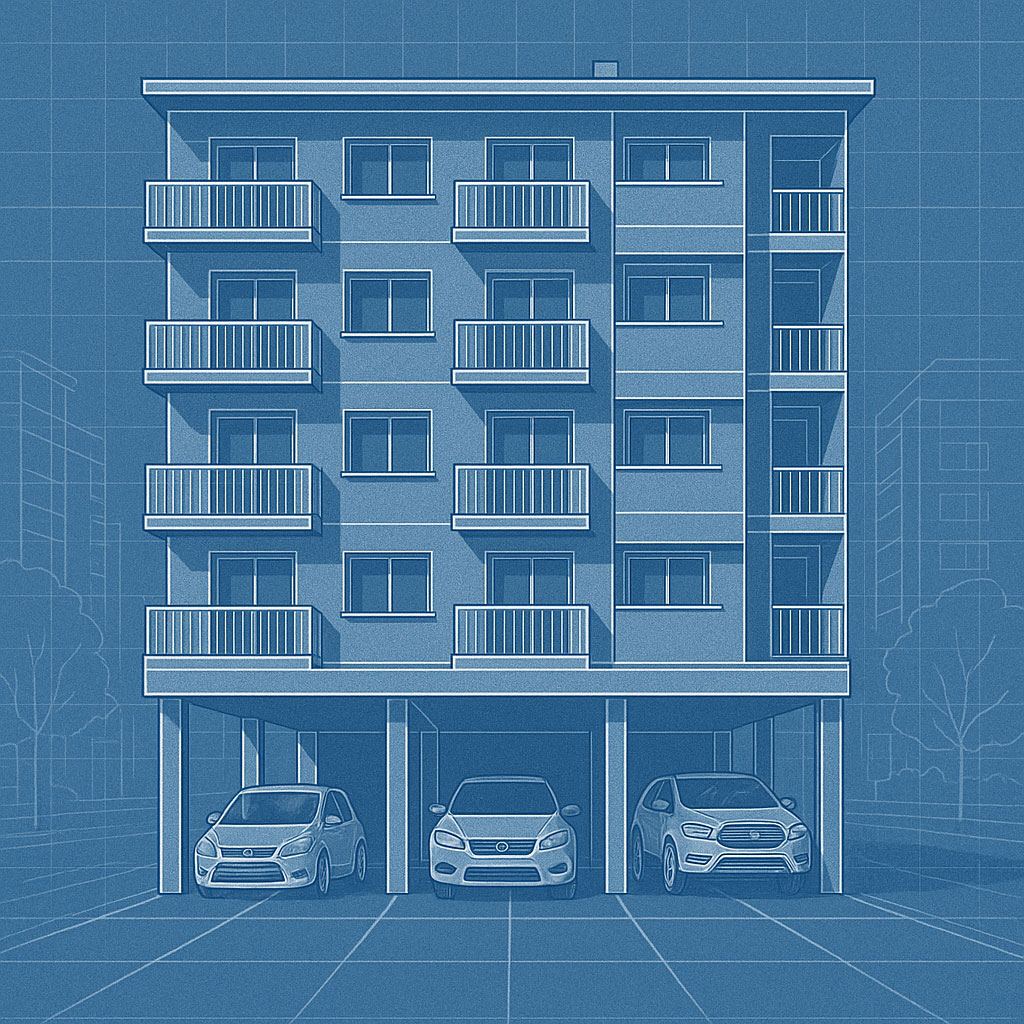
The use of the pilotis as a parking space is common practice in Greek apartment buildings. However, its legality and the possibility of exclusive use are not self-evident and often raise questions for owners and managers. The pilotis is a common and jointly owned part of the property, which means that its use is governed by specific urban planning and legal principles.
With recent changes in legislation, and in particular Law 5005/2022, the status of parking spaces in pilot areas has been clarified and made more functional. Below is everything an owner or manager needs to know.
1. The pilot as a shared space – What this means in practice
The pilotis, like the stairwell or the uncovered area, belongs indivisibly to all co-owners. Even if it has been used for parking for a number of years, this is not sufficient to create ownership rights to a specific location.
Before 2022, an open parking space in the pilot could not be horizontal property, so it could not be transferred or have exclusive use without a unanimous decision.
2. What changed with Law 5005/2022
The new law introduced significant simplifications:
✔ Conversion of open position to apartment monitoring
The owner can now include the open parking space in the pilot as part of his horizontal property.
✔ Possibility of transferring the position to another co-owner
The position can be sold, provided that the buyer is the owner of another apartment in the same building.
✔ Integration into the co-ownership percentage
The position is now linked to a percentage of the land, without requiring the unanimous consent of all co-owners.
✔ Complete legalization of parking
With the establishment or modification of horizontal properties, the use of the pilotis for parking becomes fully legal and binding.
3. Who is permitted to use the seats in the cockpit?
Parking spaces may only be used by owners or tenants of apartments in the apartment building.
It is prohibited to sell or rent to a person who does not own property in the same building.
Old seats purchased before the law was banned remain privately owned and can be transferred.
4. How parking spaces are determined in new buildings
The engineer calculates the required number of seats based on:
the use of the building,
the total surface area measured in the SD,
special features (e.g., rooms, beds, spectators).
Before a permit is issued, a parking diagram is submitted to a notary public, in which all parking spaces are bindingly defined — in the basement, the pilotis, the uncovered area, or even the rooftops.
5. Where parking spaces can be found
The positions can be located:
in the pilot
in the basement
in the uncovered
on the floor
on the terrace
It is sufficient to ensure:
➡ at least 12 square meters of surface area,
➡ sufficient maneuvering space,
➡ safe access.
6. Open vs. closed parking spaces – What applies
Open parking spaces
They are not separate property.
They are provided exclusively for use, not for ownership.
They cannot be transferred or rented to third parties outside the building.
Closed spaces (gate with enclosed area or underground garage)
They constitute horizontal property.
They have a percentage of the plot of land.
They may be sold and rented without restrictions, unless prohibited by the regulations.
7. What happens when parking “anarchy” prevails in the pilot program?
In case of trespassing on a public right of way, parking in front of an entrance, or lack of signage:
the building permit plans are examined,
the legitimacy of the positions is checked,
urban planning authorities may intervene in the event of violations.
8. Spaces in underground garages
Spaces in the basement or enclosed ground floor are considered divided properties.
They are not shared and can be freely transferred.
9. Can I convert the uncovered area into a parking space?
The main use of the uncovered area is for planting.
However, it can serve as a parking space:
in an unhoused form or
lightweight construction,
provided that the limit is not exceeded and 2/3 of the mandatory planting is maintained.
10. Which buildings are exempt from the obligation to provide parking spaces?
They do not require parking spaces:
buildings constructed before 1979,
traditional buildings being restored,
properties in designated traditional settlements with special conditions,
buildings that are rebuilt after earthquakes with the same surface area and use.
Conclusion
The legality of parking in the pilot area now has a clear framework, but requires the right technical and legal approach. With the changes introduced by Law 5005/2022, owners have more rights and flexibility, but also more obligations in terms of proper construction, use, and management.
City Engineering undertakes:
- title and horizontal property checks,
- consulting for exclusive uses & monitoring,
- parking diagrams,
- urban planning inspections and regularizations,
- preparation of technical files for notarial acts.