



Application of external thermal insulation with rock wool
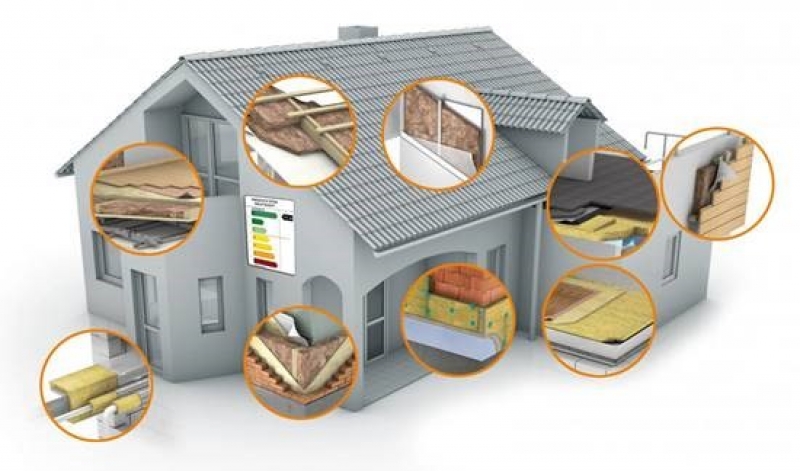
Knauf Insulation’s external thermal facade with rock wool is designed for additional insulation of existing uninsulated or inadequately insulated buildings as well as new buildings, achieving thermal insulation, sound absorption, fire protection, and balanced humidity in the interior.
Preparation
1. Installation of the lower base profile: A metal profile is fixed to the bottom with anchor plugs (maximum 3 pcs/m). This profile provides a flush finish to the facade, protects the bottom edge of the slab, and allows the insulation material to be placed on a horizontal base.
2. Applying adhesive: The adhesive for rock wool is applied around the perimeter of the slab and in spots on its inner surface. At least 40% of the slab surface must be covered with adhesive. The adhesive must not penetrate between the slab joints.
3. Pasting the rock wool slabs onto the base wall: FKD-S rock wool slabs are placed close to each other, pressing one slab next to the one that was pasted first. The next row should be placed at a distance of half a slab from the previous row. The smoothness/flatness of the outer surfaces is then checked with a guide of suitable length (e.g., with a piece of profile or a piece of wood). At corners, windows, and doors, whole boards should be placed to avoid cracks in the corners of the final layer of mortar.
4. Fixing rock wool slabs with anchor plugs: The recommended anchor plugs are polyethylene with steel screws and a head diameter of 60 mm. Proper fastening of the slab is achieved with 6 anchor bolts per square meter (3 anchor bolts per slab), noting that 8-14 anchor bolts per square meter are used at the corners of the building.
5. Installation of corner beams with glass mesh and reinforcement at the corners of the openings: Before applying the first layer of adhesive in which the glass mesh is embedded, all corners of the building and openings on the facade must be reinforced with corner beads with glass mesh. To prevent cracking on the facade, an additional strip of glass fiber mesh must be placed at the corners of the openings at a 45° angle to the opening, measuring 20x40cm.
6. Application of adhesive in which reinforced mesh is embedded: In the first layer of fresh and uniformly applied adhesive, reinforced alkali-resistant glass fiber mesh is embedded. It is necessary to overlap the pieces of glass fiber mesh by at least 10 cm. A second layer of adhesive is then applied so that the glass fiber mesh is positioned one third of the thickness of the adhesive on the outside.
7. Application of primer and final coat on the facade: In accordance with the manufacturer’s instructions, a suitable primer for the final coat of the facade, as specified in the specifications, is applied over the dry adhesive. We recommend decorative mortars for the final coat of the facade.
Source: Magazine “News of Greek Building Contractors”