



What should they know the owners about the mandatory fire protection measures for in properties within or nearby forested areas ?
What does the new fire protection regulation concern?
The regulation aims to establish a uniform and mandatory application framework measures and means of fire protection for the properties that are located within or nearby forests and forestry areas. It specifies measures for preventive fire protection as well as and minimum requirements for passive and active fire protection, both for the buildings, newly constructed and existing, as well as for the surrounding area of their, in order to to strengthen the degree of fire safety of the property, to reduce its vulnerability to fire and a64> to limit its contribution to the spread of it.
Which properties (plot of land or site together with the building within it) does the application of the new provision apply?
This concerns the properties that have buildings and are located:
- in forests or forest ecosystems or forest areas.
- on grassland areas located on semi-mountainous, mountainous, and uneven terrain, whether public or recognized as private.
- on lowland grasslands (not mountainous or semi-mountainous and not located on uneven terrain).
- are located wholly or partly within a radius of 300 meters from the boundaries of forest areas.
- are located within peri-urban green areas and in designated forest or reforestation areas.
- are located in parks and groves in cities and residential areas.
How can I find out if my property is located in a dangerous area?
You should consult an engineer to locate your property on the forest map and then examine whether there is an obligation to prepare a fire protection study.
What must be done by the owner of the property that falls under the regulation?
You should immediately contact an engineer/qualified technical scientist who will inspect the property and the building and then draw up a Risk Assessment Form and Technical Report.
What will the engineer’s report include?
Following an inspection, the engineer/technical scientist examines the risk criteria for the property and completes the risk assessment form, which determines its classification.
In continuation drafts report in which includes in any case the following:
Description of the property, the building, its facilities, and the surrounding area, with reference to the data documenting the selection of criteria for classifying the property in terms of its risk and the fire protection measures applied (the location of the property in relation to forest areas and neighboring buildings, geometric characteristics, building materials, vegetation, etc.).
Required preventive measures, passive fire protection measures, and active fire protection measures.
A floor plan of the property showing the necessary details, such as the locations of main and auxiliary buildings, access to the property, protection zones, the locations and distances of trees, the distances of neighboring buildings, etc.
What applies to existing buildings?
In the case of properties with existing buildings, the technical report shall also list the actions and works that need to be carried out.
The proposed measures are preventive, passive, and active (suppressive) fire protection and should be applied in their entirety to new buildings, while for existing buildings it is provided that:
a) The risk assessment form and the report of the competent technical scientist with accompanying data shall be submitted by an authorized administrator by March 31, 2024. The property owner must, within one month of the above date and for each subsequent year until April 30, 2024, must submit a fire safety measures implementation statement declaring that they have taken all necessary actions and meet the requirements of the regulation for the protection of their property in the event of a fire, as specified in the report of the competent technical scientist.
b) Preventive fire protection measures are mandatory starting this fire season.
c) Passive and active fire protection measures must be implemented by March 31, 2025, for properties classified as high and very high risk, and by March 31, 2026, for properties classified as low or medium risk.
Where does the owner submit the required documents?
After the Technical Report has been drafted, the property owner is required, within one month of the above date and, in any case, by 30/4/ 2024, to submit a Declaration of Implementation of Fire Safety Measures, in which they declare that the measures provided for in the report of the competent technical scientist have been properly implemented, based on the provisions of the regulation for the protection of their property in the event of a fire fire.
Until the special electronic platform is operational, on which the Risk Assessment Form, the Report of the competent technical scientist and the Declaration of Implementation of fire safety measures by the owner, the above information shall be submitted in duplicate in printed form to the relevant Municipality.
I have a fire safety file for my building in my building permit. Why is a new study necessary?
This regulation specifies fire protection measures and minimum requirements for passive and active fire protection, both for buildings, newly constructed and existing, as well as for their surrounding area, in order to reduce their vulnerability to fire and limit their contribution to its spread.
The measures introduced by the regulation apply in addition to the requirements of the relevant building fire protection regulation and firefighting provisions for preventive fire protection and prevail if they are more stringent.
Furthermore, the requirements of this regulation apply in parallel with the requirements of other specific regulations governing the safety and functionality of structures or their installations (e.g., earthquake protection, energy efficiency, lightning protection, accessibility, etc.).
What basic measures must be in place?
Preventive fire protection measures include, among others:
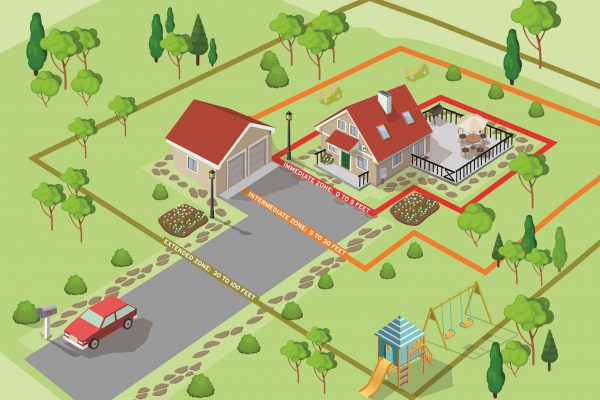
Access to the property, creation of a protection zone with a minimum width of ten meters on three levels in order to slow down the spread of fire and allow firefighters to intervene.
At the same time, it is prohibited to store combustible or flammable materials and objects, to store firewood near buildings, and to store flammable materials such as fuel for gardening equipment, etc.
For existing buildings, however, the maintenance of legally installed existing above-ground gas fuel tanks will continue to be permitted on an exceptional basis until December 31, 2030.
In addition it is necessary to regularly clean the courtyards, the roof and the gutters from debris and remnants of vegetation.
Οι ιδιοκτήτες κάθε ακινήτου στις περιοχές αυτές θα πρέπει να προχωρήσουν στην κατάρτιση σχεδίου προετοιμασίας εκκένωσης σε περίπτωση πυρκαγιάς.
Fencing is also mandatory for existing buildings.
It is also mandatory to replace or add metal fiber mesh to the building’s window frames for high-risk and particularly high-risk properties.
In the event of renovation, it is also mandatory to invest in the building with non-combustible materials. a8> building with non-combustible materials (e.g. plaster, brick, stone, etc.).
Who monitors compliance with fire safety measures ?
Compliance with the requirements of the regulation is checked following an on-site inspection by a three-member committee appointed by the relevant municipality and consisting of a forester or agronomist, an engineer, and another employee of the municipality’s Civil Protection Department.
What are the penalties for those who do not comply?
In the event of non-compliance with the requirements of the regulation, administrative and criminal penalties are imposed on property owners. Administrative fines constitute revenue for the relevant municipality.